
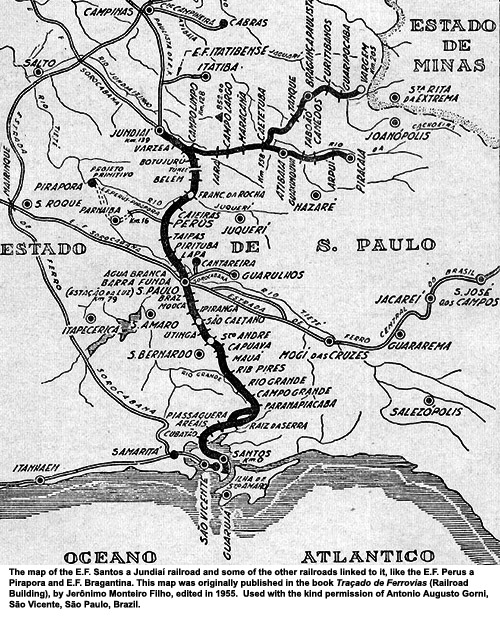
 The São
Paulo
Railway was first proposed in the 1830s by Brazilians looking for a
method of
transporting their large coffee crops to the coastal
ports. It was not until 1856 that the Brazilian government
gave a
concession for the construction of the railway from Santos to Jundiahy,
70 km north of the city of São Paulo.
The São
Paulo
Railway was first proposed in the 1830s by Brazilians looking for a
method of
transporting their large coffee crops to the coastal
ports. It was not until 1856 that the Brazilian government
gave a
concession for the construction of the railway from Santos to Jundiahy,
70 km north of the city of São Paulo.The Baron de Maua enlisted the help of British engineer James Brunlees, who in turn hired his former student D.M. Fox, to undertake a survey of the São Paulo area. Brunlees approved the survey and Messrs. Robert Sharpe & Sons of England were engaged as contractors, hiring about three hundred workers. Construction of the São Paulo Railway began in 1860, necessitating the navigation of the almost vertical slopes of the Serra do Mar area which separates the interior from the coast. The 139 km line, completed in 1867, was the main link between the São Paulo highlands and the Santos harbour.
The São Paulo Railway Company of Brazil was originally an English company and remained as such for many years; it became the most profitable British owned railway company of the time. In 1946, the Brazilian government took over the company and renamed it Estrada de Ferro Santos a Jundiai. In turn this railroad became part of the Rede Ferroviaria Federal Sociedade Anonima (RFFSA)in 1957.
Sources:
“59 A Gateway to Brazil”: The Trunk Line that Climbs a Precipice”.
In https://mikes.railhistory.railfan.net/r059.html
“A Brief History of the Brazilian Railways”.
In https://www.geocities.com/CapeCanaveral/2376/e_hist.htm
“Estrada de Ferro Santos a Jundiai”.
In https://www.pell.portland.or.us/~efbrazil/efsj.html
UNB Archives
Contact Website Administrator
Last Update: 2004/03/31